Every year a letter arrives that looks like a page from a chemistry textbook. It is your water quality report: a table of abbreviations, decimals, and numbers followed by letters. Most households glance at it and file it, unread.
Learning how to read your water quality report is simpler than that page of numbers suggests. The document is short, and it answers a question most households never get answered directly: what the local water system found in the water it delivered, and whether any of it mattered.
The document is also about to change for the first time in years. The report you receive next year will follow a new set of rules.
What the report is, and when it should arrive
EPA requires community water systems to deliver a Consumer Confidence Report to their customers. It is a summary of your local drinking water quality: where your water comes from, what the system found in it, and what those findings mean.
In practice, the document goes by several different names. A water utility might call it the Consumer Confidence Report, the CCR, or the annual water quality report, and all three refer to the same document. Reports must be sent by your water supplier each year by July 1.
The requirement applies to community water systems, so households that draw from a private well do not receive one at all. If your water arrives through a bill from a town, city, or utility, then this report is yours.
What has to be in it
Open the report and the first thing you should see is where your water comes from, such as a lake, a river, or an aquifer. Next to it is a short summary of the risk that the local source could become contaminated.
The middle of the report lists the regulated contaminants found in the local drinking water, together with the levels the system detected. If any contaminant was found in violation of an EPA health standard, the report must spell out its potential health effects and what the system did to restore safe drinking water.
Some reports also carry educational information on nitrate, arsenic, or lead where these may be a concern in the local supply, plus a statement for vulnerable populations about avoiding Cryptosporidium.
At the end come the contact numbers for follow-up questions, including the water system’s own line and EPA’s Safe Drinking Water Hotline. State reports may add state-specific information, but they must still carry the federal basics.
A number in the table is not automatically a problem
The table in the middle is where most people stall, and it is easier to read than it looks. It reports what the system detected. A detection below the regulatory limit is the ordinary case, not a warning. A table with entries in it is a normal table.
The report draws a line between a detection and a violation. A detection says the system found something. A violation says a finding crossed the line, and only a violation triggers the health-effects language and the account of what the system did about it. If that language is absent, nothing in the table crossed a standard.
That leaves the abbreviations. Terms like MCL, MCLG, and action level show up in these tables, and none of them are general knowledge. You do not need to memorize them, because every report carries its own key or definitions panel. That panel is the right place to look when a term is unfamiliar.
What changes in 2027
The report in front of you follows the old rules, and the next one will not. EPA announced the final rule revisions on 15 May 2024 and set 1 January 2027 as the compliance date, which means reports delivered in 2027 must meet the revised requirements. The stated goal is short: “Starting in 2027, the final rule will ensure that these reports are easier to read.”
The change households will notice is the schedule. Under the revised rule, “systems serving over 10,000 customers will be required to distribute reports twice per year.” A household on a larger system will get two documents a year instead of one. Smaller systems stay on the annual schedule.
Two further changes are worth knowing. The rule is intended to “support access to translations in appropriate languages”. EPA also describes it as “enhancing information about lead in drinking water.”
The revision has been coming for a while. Congress directed it through America’s Water Infrastructure Act of 2018.
When the report does not answer your question
The report describes the water the system delivers, not the water at your own tap. What happens inside the building’s own plumbing sits outside the system’s testing, so the report cannot speak to it. If the pipes in a house are the concern, the report is the wrong tool for that question.
The same gap applies to private wells, in a bigger way. A household on a private well receives no report at all, so the information has to come from testing. There is no annual document to read.
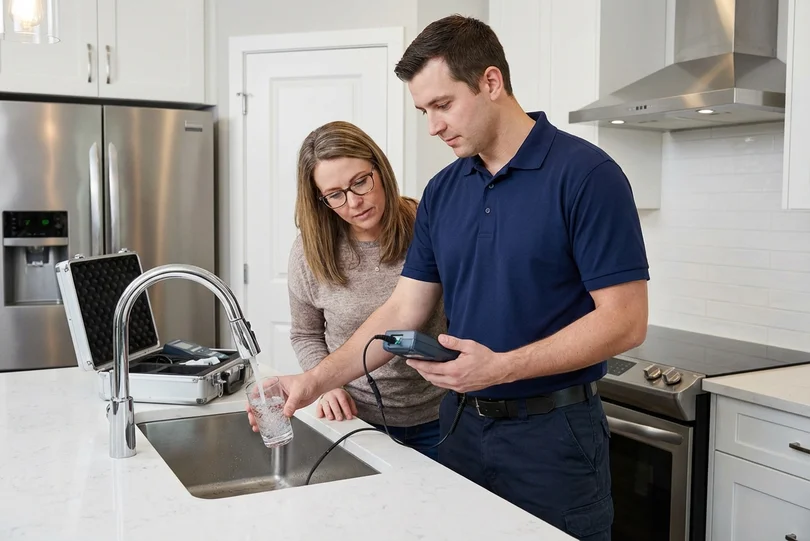
In both cases the next step is testing rather than guesswork. If you want to go beyond what the report covers, there are ways to find out what is in your tap water, and that question picks up where the annual document leaves off.
Common questionsWhy did I get two water quality reports this year?
From 2027, systems serving over 10,000 customers distribute reports twice per year under EPA’s revised rule. Smaller systems stay on the annual schedule. Two reports a year is the new normal for larger systems, and it is not a sign of a problem with the water. The change is the delivery schedule, not the water itself.
What if my water system never sent me a report?
Community water systems must deliver one by July 1 each year. If none arrived, the water system’s own contact number is the first call, and reports are frequently published on the supplier’s website. Private well households do not receive one at all.
Does the report tell me what is coming out of my own tap?
Not exactly. It describes the water the system delivers, and nothing more. Anything that happens inside the building’s own plumbing sits outside that testing, and the report has no way to account for it. That is why the report and a household test answer different questions, and why both can be worth reading.